


A new Afrobarometer report reveals strong support for cross-border movement across Africa, but also uncovers growing concerns about immigration, jobs, and refugees, even as more Africans consider leaving their home countries in search of economic opportunities abroad.
A majority of Africans support the free movement of people across the continent, according to a new Afrobarometer flagship report, but many are less enthusiastic about welcoming immigrants into their own countries.
The 2026 African Insights Report, based on interviews with more than 50,000 citizens across 38 African countries, found that while most Africans favour easier movement across borders, concerns about jobs, economic opportunities, and migration continue to shape public attitudes.
The report highlights a striking contradiction: Africans largely embrace the idea of regional integration and mobility, yet many prefer stricter limits on immigration, particularly for job seekers and refugees.
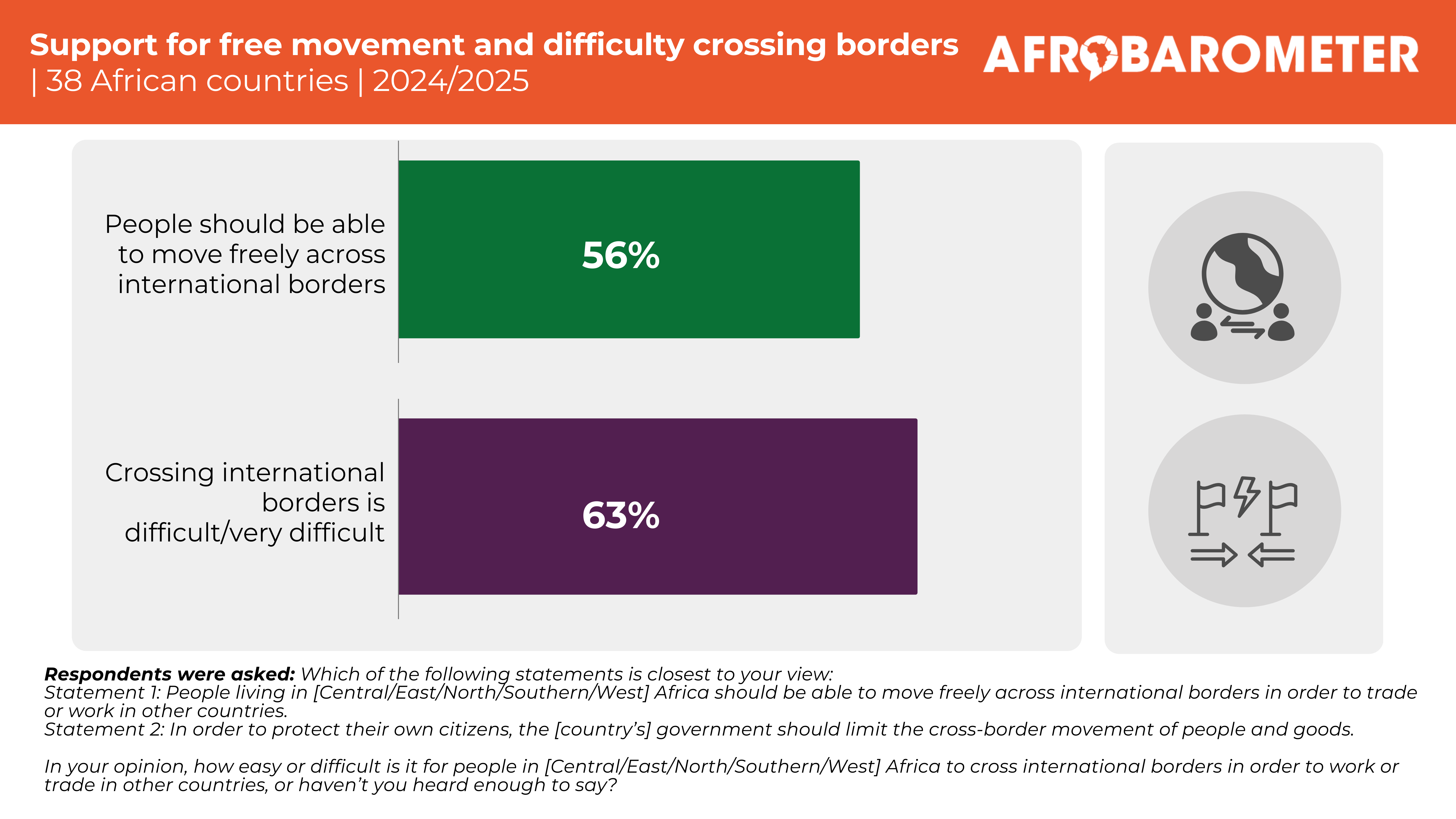
Support for Free Movement Across Africa
According to the findings, 56% of Africans believe people in their region should be able to move freely across international borders, while 40% think governments should restrict movement to protect local jobs and opportunities.
Despite this support, many Africans say crossing borders remains difficult. Nearly two-thirds (63%) of respondents described moving across borders for work or trade as difficult, while only 23% said it was easy.
The findings come as African governments continue implementing the African Continental Free Trade Area (AfCFTA), which aims to improve economic integration and mobility across the continent.
Openness to Foreigners, Concern About Economic Impact
The survey found that Africans are generally comfortable living alongside foreigners. More than three-quarters (77%) said they would welcome or not mind having immigrants or foreign workers as neighbours.
However, opinions are sharply divided when it comes to immigration’s economic effects. While 45% believe immigrants are good for their country’s economy, 44% think they have a negative impact.
Public attitudes become even more restrictive regarding future admissions. Nearly two-thirds (64%) would prefer their country to admit fewer or no foreign job seekers, while 70% favour limiting or halting refugee admissions.
One of the report’s more surprising findings is that opposition to immigration tends to be strongest among Africa’s most educated, wealthiest, and highly skilled citizens. Afrobarometer found that people with higher levels of education and skills were generally less supportive of admitting foreign job seekers than those with lower educational attainment.
More Africans Considering Emigration
While concerns about immigration are growing, the report also shows that increasing numbers of Africans are considering leaving their own countries.
Nearly half (45%) of respondents said they had thought about emigrating, including one-quarter (25%) who said they had considered it seriously.
West Africans were the most likely to express a strong desire to move abroad, with 34% saying they had given serious thought to emigrating. That figure was more than double the level recorded in East Africa and North Africa, where only 16% reported similar intentions.
The trend appears to be accelerating. Across 31 countries surveyed in both 2016-2018 and 2024-2025, the proportion of people who said they had thought “a lot” about emigrating increased from 18% to 25%.
Young people and the highly educated are leading this trend. About 32% of Africans aged between 18 and 35 said they had seriously considered emigrating, compared with 31% among the most educated respondents.
Economic Pressures Driving Migration
Economic concerns remain the primary factor behind migration aspirations.
Among those who have considered emigrating, half said they would leave in search of employment opportunities, while another 29% said they would move abroad to escape economic hardship.
When asked about preferred destinations, Europe emerged as the leading choice, attracting 32% of potential migrants. North America followed closely at 28%.
Only around one in five prospective migrants said they would move within their own sub-region (17%) or elsewhere in Africa (5%).
The report also noted a significant decline in interest in relocating within Africa. Across 31 countries tracked over time, the share of respondents preferring another African country as their destination fell from 36% in 2016-2018 to 26% in 2024-2025.
Snapshot of Africa’s Global Outlook
The African Insights 2026 report is the third edition of Afrobarometer’s annual flagship publication. Drawing on 50,961 face-to-face interviews conducted during 2024 and 2025, it explores African public opinion on trade, migration, global power competition, climate change, and the continent’s role in international affairs.
The findings suggest that Africans broadly support regional integration and mobility, but economic uncertainty continues to shape how they view migrants arriving in their own countries. At the same time, growing numbers of citizens are looking beyond the continent in search of better opportunities, reflecting persistent concerns over jobs and living conditions at home.
