
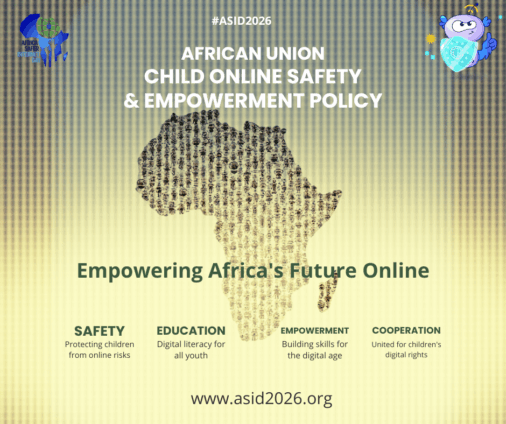

The African Union’s leadership in advancing child online safety and digital empowerment was in focus as stakeholders from across the continent gathered in Accra, Ghana, for the Africa Safer Internet Day (ASID) 2026 Leadership Forum.
Held under the theme “Together for a Better Internet: AU Online Safety Policy in Action,” the forum highlighted the transition from continental policy adoption to coordinated implementation across AU Member States.
The high-level hybrid forum, hosted at Studio 502 in Adabraka and livestreamed for regional participation, coincided with Safer Internet Day on February 10, 2026. Central to the discussions was the African Union Child Online Safety and Empowerment Policy, adopted in February 2024.
As the first regional policy framework of its kind globally, the policy establishes common principles to safeguard children’s rights to safety, privacy, participation, and empowerment in the digital environment, while outlining ten strategic goals for domestication by Member States.
Opening the forum, Awo Aidam Amenyah, Executive Director of Child Online Africa, emphasized the urgency of translating the AU policy into concrete national action, noting that its success depends on effective legislation, enforcement, and public awareness at country level.
John Omo, Secretary General of the African Telecommunications Union (ATU), reaffirmed Africa’s position as a global pioneer in rights-based child online protection, stressing that continental leadership must now be matched by consistent execution.
A keynote address by Dr. Tulia Ackson, President of the Inter-Parliamentary Union (IPU), underscored the central role of parliaments in aligning national laws and budgets with the objectives of the AU policy. She called for strengthened legislative oversight and inclusive, multi-stakeholder engagement to ensure that children’s digital rights are fully embedded within national governance frameworks.
From a regulatory perspective, Ms. Anne Rachel Inne of Niger’s Agency for the Information Society stressed that the AU policy must move beyond institutional spaces to reach citizens and communities. She noted that sustainable online safety is built through informed and empowered users who understand their rights and responsibilities. Ms. Saudatu Shehu Shagari of the Nigerian Communications Commission echoed the importance of awareness-raising, regulatory strengthening, and balanced enforcement aligned with AU policy principles.
A video presentation by learning scientist Dr. Jared Cooney Horvath highlighted research on children’s screen time and learning outcomes, reinforcing the need for evidence-based approaches in implementing digital education strategies in line with the AU framework.
Panel discussions moderated by Dr. Justina Asafu-Adjaye reflected the AU’s whole-of-society approach to child online safety, with contributions from media, technical institutions, and the private sector. Henry Kabwe of the Media Network on Child Rights and Development emphasized the role of journalists in promoting positive digital content and countering online harms, while Kwaku Antwi of the Ghana Domain Name Registry outlined how technical compliance mechanisms can support safer online ecosystems.
Private sector participation highlighted the role of industry in supporting AU policy implementation. A representative from MTN Ghana outlined ongoing efforts in safer product design, reporting mechanisms, and digital literacy programmes. Mr. Samuel Bartels emphasized the shared responsibility of infrastructure providers, noting that parental digital literacy is increasingly as critical as child digital literacy.
Creative industry voices also reinforced alignment with AU objectives. Mr. Gregory Arthur, CEO of Studio 502, underscored the importance of safe digital production environments, stressing that responsible content creation is essential to protecting children online and nurturing positive digital participation.
Addressing continental obligations, Hon. Poloko Nuggert Ntshwarang, Rapporteur of the AU Committee on Children’s Digital Rights, outlined Member States’ responsibilities under the policy, including strengthening legal frameworks, investing in education and capacity building, and promoting meaningful child participation in digital governance. Dr. Emmanuel Manasseh, ITU Regional Director for Africa, highlighted synergies between the AU policy and ITU initiatives aimed at harmonizing standards and supporting Member States through technical assistance.
Representing the host country, Dr. Jamal Tonzua Seidu, Deputy Director General of Ghana’s Cyber Security Authority, called for stronger alignment between national strategies and AU-level commitments to ensure consistent levels of protection for children across the continent.
Media and digital content leaders, including Ameyaw Debrah and Richard S. Quashie of MG Digital, highlighted the influence of online platforms and content creators in shaping children’s digital experiences, emphasizing responsibility, constructive storytelling, and the need to address online harm without limiting youth expression.
In his closing reflections, ATU Secretary General John Omo stressed that the AU policy provides a minimum continental foundation that must be reinforced through collaboration and sustained implementation. He noted that connectivity alone is insufficient without productive, safe, and empowering digital use.
The ASID 2026 Leadership Forum reaffirmed growing momentum behind Africa-led, AU-anchored action to protect and empower children in the digital age. As the discussions underscored, translating the African Union’s Child Online Safety and Empowerment Policy into meaningful impact will require coordinated action by Member States, regional institutions, industry, civil society, and children themselves—working together for a better internet for Africa.
