
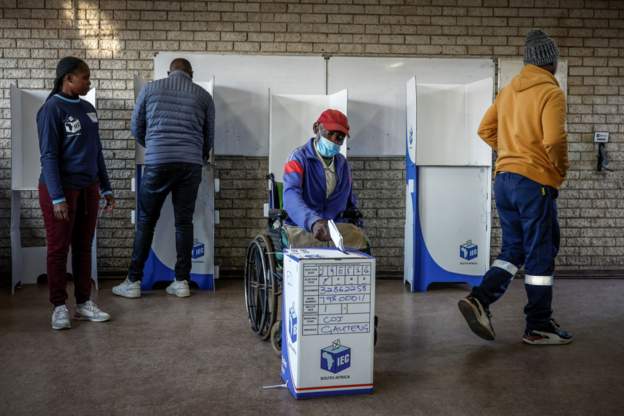

South Africa’s governing African National Congress (ANC) is facing fresh political pressure after suffering significant losses in last week’s municipal elections, setting the stage for difficult coalition negotiations across several key cities.
With nearly all votes counted, the ANC had secured about 31% of the national vote, ahead of the opposition Democratic Alliance (DA), which garnered roughly 25%. Former president Jacob Zuma’s uMkhonto weSizwe (MK) party placed third with around 10%, while support for the remaining votes was fragmented among numerous smaller parties.
The results underscore the ANC’s continuing decline in local government elections, reflecting growing public frustration over service delivery challenges, including water shortages, electricity problems and deteriorating municipal infrastructure.
No single party won outright control in several major municipalities, including Johannesburg, meaning coalition negotiations will now determine who governs many of South Africa’s most important urban centres. Political parties have up to two weeks to reach agreements before new municipal councils are formed.
ANC Secretary-General Fikile Mbalula described the party’s performance as a serious setback, acknowledging voter dissatisfaction and calling for internal reforms.
In Johannesburg, the DA emerged as the strongest party with about 35% of the vote, significantly ahead of the ANC’s roughly 20%. The outcome could strengthen the chances of veteran DA politician Helen Zille securing the mayoral position, depending on the outcome of coalition discussions.
The DA has already signalled its intention to engage parties it says share its commitment to accountability, improved public services and anti-corruption measures.
The municipal election outcome is being closely watched as a key indicator of South Africa’s evolving political landscape ahead of future national elections. Analysts say the results highlight the growing influence of coalition politics and the continued erosion of the ANC’s dominance more than three decades after it came to power at the end of apartheid.
