
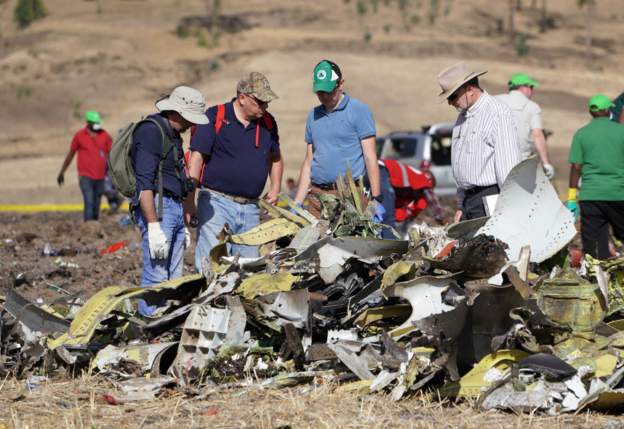

Details of the first report of investigations into the Ethiopian airliner crash in March have been revealed by Ethiopian officials.
The report showed that pilots of the jet followed all procedures but were unable to take control of the plane.
Ethiopia’s minister of transport Dagmawit Moges on Thursday said the pilots did not ignore proper guidance in the fatal crash of a Boeing MAX 8 airplane.
Dagmawit told a news conference in the capital, Addis Ababa that “The crew performed all the procedures repeatedly provided by the manufacturer but was not able to control the aircraft.”
The chief executive of Ethiopian Airlines, Tewolde GebreMariam has reacted to the first part of the investigative report.
In a statement GebreMariam said he was “very proud” of the pilots’ “high level of professional performance”.
“It was very unfortunate they could not recover the airplane from the persistence of nose diving,” the airline said in a statement.
#Ethiopia|n Airlines Statement on the Preliminary Report of the Accident on ET 302 pic.twitter.com/azAKxyptq8
— Ethiopian Airlines (@flyethiopian) April 4, 2019
The Ethiopian Airlines flight crashed shortly after taking off from Bole International Airport in Addis Ababa. It was en-route to Nairobi Kenya.
The pilot of #ET302 (Boeing 737 MAX 8) is said to have reported difficulties with the aircraft to ATC.

Final moments on jet revealed
Last month details of the final moments before the crash that killed 157 people were revealed.
Wall Street Journal reported that people close to the ongoing investigation said information about the incident “paints a picture of a catastrophic failure that quickly overwhelmed the flight crew”.
According to Wall Street Journal reporting, soon after take-off the aircraft’s nose began to pitch down.
One pilot then said to the other “pitch up, pitch up!”. Shortly after those words the radio of the aircraft went dead.
There were more than 30 different nationalities on board the Ethiopian airliner that crashed. Kenya was the worst hit with 36 citizens dying.
Leaked details from the ongoing investigation blamed the crash on an automatic anti-stall system.
The anti-stall system was reportedly activated at the time of the disaster.
Ethiopian officials have said that the Addis Ababa crash had similarities with last year’s Indonesia air crash.

Concerns over Boeing jets
Following the crash concerns quickly emerged about the Boeing 737 Max. That led to a global grounding of the plane.
The jet producer has now redesigned its software to disable MCAS. Boeing is also to install an extra warning system on all 737 Max jets.
There would be revised training for pilots to “enhanced understanding of the 737 MAX” flight system and crew procedures.
Source: Africafeeds.com
