

DXY can rise or fall for several reasons at once. The most useful way to read the move is not to hunt for a single explanation, but to identify the dominant driver.
Three questions to ask
Did US rate expectations change? Higher expected rates can support the dollar by increasing the relative appeal of dollar assets.
Was there a data surprise? Inflation, employment, retail sales and GDP can alter the outlook for Federal Reserve policy.
Did risk sentiment shift? During periods of market stress, demand for dollar liquidity can increase even when the US data calendar is quiet.
Because the euro has a 57.6% DXY weight, a major EUR/USD move can also be a direct explanation. The Federal Reserve explains how monetary policy pursues price stability and maximum employment—two areas investors follow closely in US data.
Avoid the one-headline explanation
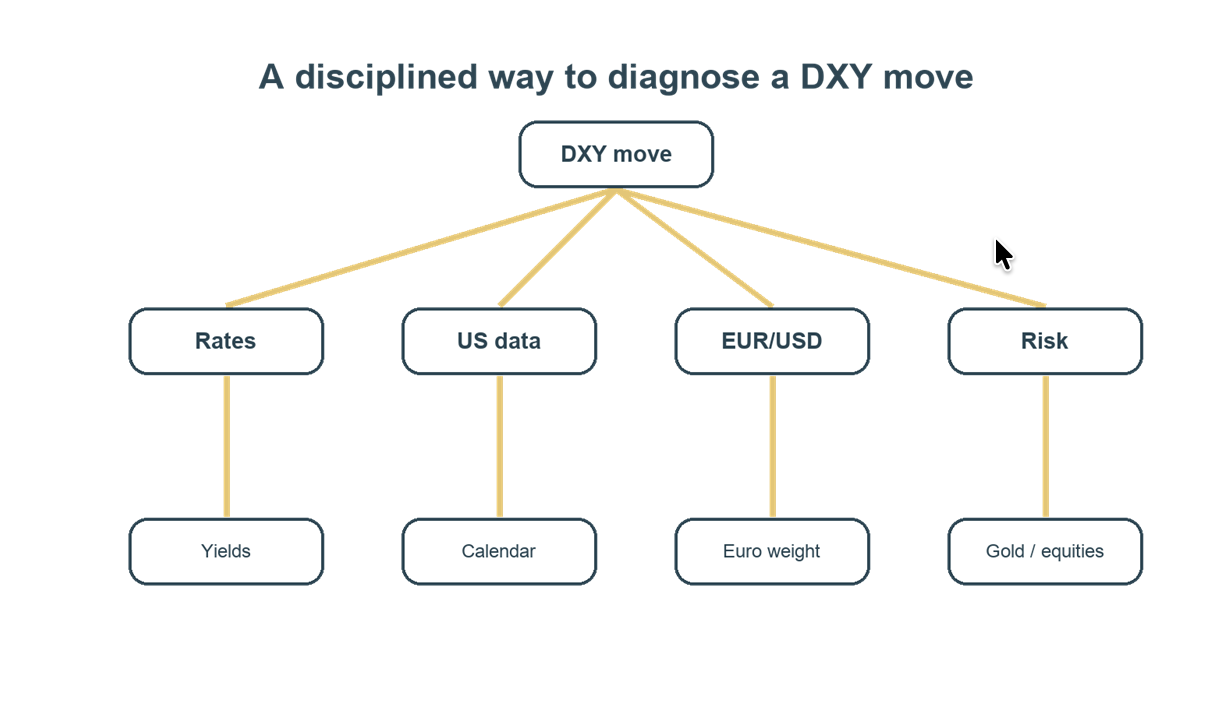
Check rates, EUR/USD, equity volatility and the event calendar together. Then consider the cost of trading the view. Exness Pro account historical DXY average-spread comparison was 83% below the industry average in the specified period, but current liquidity and event risk determine the live quote.¹
DXY is most informative when it is treated as a reaction to rates, growth and risk—not as a headline in isolation.
Read the move in sequence
Start with the calendar: was there an inflation release, labour-market number or central-bank communication? Then compare the reaction in Treasury yields and EUR/USD. If both yields and DXY rise after stronger-than-expected data, the market may be repricing US policy. If DXY rises while equities fall and volatility increases, defensive demand may be a larger part of the story.
This process does not predict the next move, but it avoids superficial explanations. “The dollar rose today” describes the chart; it does not explain why the price moved or whether the move is likely to have implications for gold, US equities or emerging-market currencies.
Keep costs separate from conviction
Even a high-conviction macro view needs a viable live trade. Check DXY pricing, position size and scheduled events before entering. Conviction does not make a wide spread or an oversized position less risky.
Why a DXY chart needs context
An index can rise because the dollar is strong, because the euro is weak, or because both are true. DXY gives the result of those relative moves, not a complete diagnosis. Compare it with the yield curve, EUR/USD and the scheduled US releases before turning a one-day move into a trading thesis.
Avoid chasing the second headline
By the time a broad explanation is circulating, much of the first price reaction may have already occurred. A better approach is to define the conditions under which the move remains valid—such as continued yield support or a break of a technical level—rather than entering solely because DXY has already moved.
A daily DXY diagnosis
| Observation | Possible interpretation | Confirmation to seek |
| DXY up, yields up | Rate expectations repriced | US data and yield curve move |
| DXY up, equities down | Defensive demand or tighter conditions | Volatility and credit response |
| DXY down, EUR/USD up | Euro component may be leading | European data and ECB expectations |
| DXY flat, USD/ZAR moves | Local factors may dominate | Commodity and South Africa-specific news |
The diagnosis should stay provisional. Markets can change the reason they are moving within the same day. A data surprise may initially lift the dollar through rates, then later weigh on it if investors decide it threatens growth. The ability to revise a view is a strength, not a lack of conviction.
Keep the record simple: note the event, DXY reaction, yield reaction and the live trading cost. Over time, the journal becomes more reliable than memory.
A five-minute method for reading today’s move
First, mark the time at which DXY accelerated. Match it against the economic calendar rather than relying on a headline published later. Second, inspect US two-year and ten-year yields: a simultaneous yield move often indicates a policy-expectations channel. Third, open EUR/USD because the euro is the largest DXY component. Fourth, check whether equities and gold point to growth optimism, restrictive rates or risk aversion.
The method does not guarantee the correct explanation. It narrows the possibilities using observable evidence. It also makes the analysis easier to update if the dollar reverses later in the session.
Separate explanation from entry
Knowing why DXY moved does not automatically produce a good entry. A large move may already reflect the news, the next technical level may be close, or the spread may be temporarily elevated. Define what further price behaviour would confirm continuation and what would show that the move is losing momentum.
Market-condition note. Live pricing can change as liquidity and volatility change.² Risk note. A clear explanation does not reduce the risk created by leverage.³
A useful review also records what evidence would change the conclusion. That keeps the explanation testable rather than turning it into a story that can justify any later outcome.
¹ Exness Pro Account had the lowest average DXY spreads among ten brokers during the week of 29 March–4 April 2026, comparing the tightest spread-only accounts available across brokers. The reported result was 83% below the industry average for that comparison period. Historical results do not guarantee current or future pricing.
² Spreads are floating and may widen because of market volatility or liquidity, news releases, economic events, market opens or closes, and the instrument traded. Check the live quote, contract specifications and all applicable charges before placing an order.
³ CFDs are leveraged products. They carry a high risk of loss and may not be suitable for all investors. This article is general information, not investment advice. Consider your objectives, experience and risk tolerance, and seek independent advice where appropriate.
