
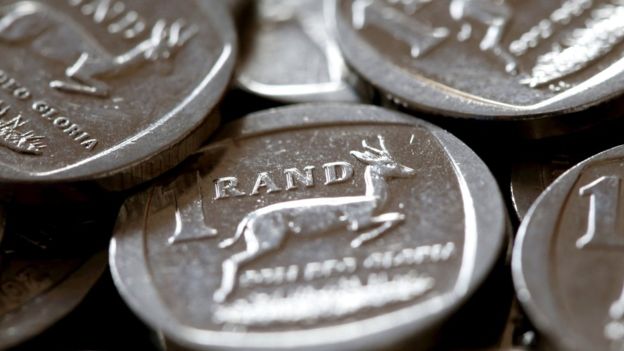

South Africa’s rand fell more than 2 percent on Monday to its weakest in almost three months after S&P Global Ratings cut the country’s credit score to sub-investment grade with a negative outlook after last week’s dismissal of the South African finance minister.
Stocks were higher on the day, led by gold shares, as demand for the safe-haven asset rose globally in response to worries U.S. President Donald Trump will use trade to pressure China in security talks.
The increased likelihood of further credit downgrades by Moody’s and Fitch is set to put pressure on the rand this week, analysts said.
“Any chance of avoiding this result evaporated last week when President Jacob Zuma sacked his respected finance minister,” John Ashbourne, an analyst at Capital Economics, said in a note. “Officials from several agencies had stressed the need to maintain the current team at the treasury.”
S&P cut the credit rating to BB+ from BBB- and assigned a negative outlook, citing fiscal policy risk following Pravin Gordhan’s sacking as finance minister.
Before President Zuma’s last Thursday to fire Gordhan, the rand was the best-performing emerging market currency year-to-date. It has now shed 11.5 percent since last Monday’s best of 12.3125 per dollar.
Bonds weakened in response to the downgrade, with the yield on the benchmark bond due in 2026 adding 14.5 basis points to 9.125 percent. Yields on South Africa’s sovereign dollar bonds rose across the curve.
Some traders, however, are betting the rand will recoup losses if Zuma is pushed out of office as anger grows over the controversial sacking inside the ruling African National Congress.
“The narrative is just so overwhelmingly negative against Zuma. The pushback has been so strong that it actually gives one a sense of confidence, and I think a lot of people are trading on this,” said ETM Analytics director and economist George Glynos.
Source: Reuters
